


































GSM tells you how much one square metre of fabric weighs. It does not tell you the weight of the complete BJJ gi. A jacket described as 380 GSM uses fabric weighing 380 grams per square metre; the finished suit also includes trousers, a collar, stitching and reinforcements. That distinction matters when you compare gis for training, travel or a competition weigh-in.
This guide helps you read those specifications, compare pearl weave and ripstop, and decide which details deserve your attention before buying. It uses examples from the current Macaco Branco range rather than treating every lightweight gi as the same product.
What does GSM mean on a BJJ gi?
GSM stands for grams per square metre: the mass of a fixed area of fabric. On a gi listing it commonly describes the jacket fabric. Check the trousers separately because they may use a different material and weight designation.
For the same fabric area, 450 GSM weighs more than 380 GSM. However, you cannot subtract the two numbers and conclude that the complete 450 GSM gi is 70 grams heavier. Sizes, cuts and the amount of material differ, and the listed number does not include every component.
It helps to separate four questions:
- Fabric weight: what GSM is specified for the jacket?
- Construction: what weave, trouser fabric and reinforcements are used?
- Fit: does this particular cut suit your body and movement?
- Complete weight: how much does your size weigh, with everything you must wear?
A product name containing a number is not a substitute for a written material specification. If the listing does not state the GSM, ask rather than assuming that the model name supplies it.
350 vs 380 vs 450 GSM: how to compare them
Use GSM as a starting point, then compare the rest of the garment. The difference between 350 and 380 is 30 grams per square metre, approximately 9% of the lighter fabric's mass. That is a fabric comparison, not a prediction that one complete suit weighs 9% more or feels 9% warmer.
Similarly, a 550 GSM jacket fabric has more mass per square metre than a 450 GSM fabric. The number alone cannot prove that it will last longer, breathe better or suit your style of training. You still need to examine seams, fit, fabric composition and care requirements.
Rather than looking for one universally “best GSM”, compare two or three models in the size you actually wear. A comfortable sleeve and trouser cut can matter more in training than a small difference in the specification.
Pearl weave and ripstop describe different constructions
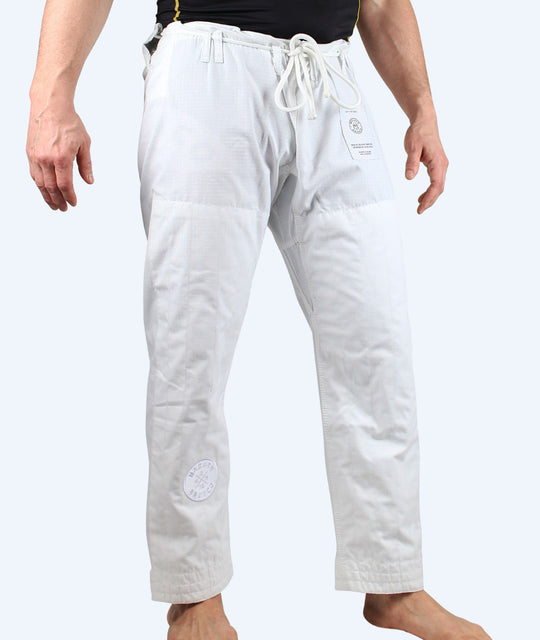
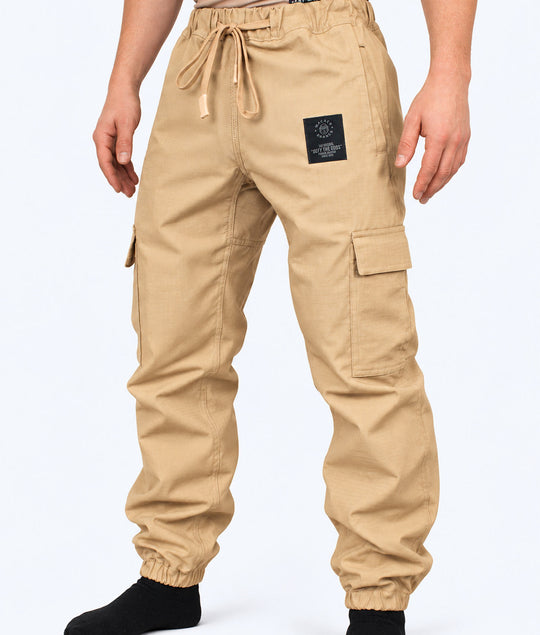
Pearl weave is a textured woven fabric used in gi jackets. Ripstop has a reinforcing grid and is often used for gi trousers. Neither term is a complete quality rating, and they are not necessarily competing options: one gi can have a pearl-weave jacket and ripstop trousers.
The Premium Green Camo gi, for example, pairs a 350 GSM pearl-weave jacket with 8 oz ripstop trousers. The Premium Khaki gi uses a 380 GSM pearl-weave jacket and also lists 8 oz ripstop trousers. Both include camo reinforcement details and an elastic waistband with a drawstring.
Keep the jacket and trouser specifications in separate columns when comparing products. An “8 oz” trouser fabric designation is not the same unit as jacket GSM, and it should not be read as the weight of the entire pair of trousers. If a seller does not specify the measurement basis, ask before making a numerical conversion.
Reading real Macaco Branco product specifications
| Model | What the listing states | What that means for your choice |
|---|---|---|
| Premium Green Camo | 350 GSM pearl-weave jacket; 8 oz ripstop trousers | A training option where your academy permits this colour. Listed as not approved for IBJJF competition. |
| Premium Khaki | 380 GSM pearl-weave jacket; 8 oz ripstop trousers | Another training option, also explicitly listed as not approved for IBJJF competition. |
| Basic 380 White | Ripstop trousers; listed complete weight of 2 kg in A3; described as meeting IBJJF's 2024 requirements | The A3 weight is a size-specific product reference. It does not establish the weight of another size or guarantee a competition inspection result. |
The Basic 380 White product page gives a useful example of a complete weight alongside trouser information. Do not compare that 2 kg figure directly with another jacket's GSM: they answer different questions. Specifications and product versions can change, so check the current listing before ordering.
Choose for your training routine
For warm rooms and frequent travel
Start by comparing lower fabric weights, but ask about complete weight and pack size if luggage space is the real constraint. Consider how the jacket fits through the shoulders and whether you have somewhere to wash and fully dry it between sessions. A low number on the label does not provide a guaranteed drying time.
For a more substantial feel
If you enjoy a heavier jacket, include higher-GSM options in your shortlist. Try to compare them with a gi you already know. The useful question is whether you like training in the complete garment, rather than whether the largest number must represent the best quality.
For a first or only gi
Prioritise your academy's uniform requirements, a suitable size and a manageable wash routine. Before paying extra for a particular weave, check whether the sleeves, waist fastening and trouser length work for you. If you train on consecutive days, a second suitable gi may solve a practical problem that a different fabric specification cannot.
Does the GSM make a gi competition legal?
No single fabric specification establishes competition eligibility. The Premium Khaki example is useful here: its listing states 380 GSM, but also clearly states that it is not approved for IBJJF competition. You must consider the whole uniform and the event's current requirements.
IBJJF's official uniform page and linked uniform rules cover requirements beyond a product's fabric description, including permitted colours, construction and measurements. Other organisers can have different requirements. Check the rules for your actual event, then use our competition BJJ gi checklist to work through fit and preparation.
If a weigh-in includes your uniform, weigh yourself in the complete dry outfit you plan to use. A retailer's sample weight is useful for shortlisting; it is not a replacement for checking your own size, belt and required clothing together.
Five checks before ordering
- Confirm the purpose. Training, travel and a named competition may lead to different choices.
- Read the actual fabric specification. Record jacket GSM and trouser material separately.
- Check the model's size chart. Compare with your measurements and a well-fitting gi, where possible.
- Read the care label and instructions. “Pre-shrunk” is not a reason to ignore washing and drying guidance.
- Resolve missing details. If weight matters, ask for the complete weight in your size rather than estimating from GSM.
For example, the Basic 380 White listing specifies washing at 30°C, line drying and no tumble drying. Apply those instructions to that model; do not assume every gi in the range has identical care requirements.
Common questions about BJJ gi weight
Is 380 GSM always better than 450 GSM?
No. It indicates less fabric mass per square metre. Your preferred feel, the cut, the trousers and your intended use still determine which complete gi suits you.
Can two gis with the same GSM weigh different amounts?
Yes. Different sizes, panel shapes, collars, trousers and reinforcements all contribute to the final weight. Compare the same size and ask whether a quoted weight covers the whole suit.
Does ripstop mean the fabric cannot tear?
No. It describes a reinforced fabric construction, not a guarantee against damage. Inspect worn seams and follow the garment's care instructions.
Ready to compare complete specifications? Browse the Macaco Branco BJJ gi collection and keep your academy or event requirements alongside the size chart.